Blog
Product updates and practical playbooks for modern teams
Stay updated on releases, learn best practices, and explore how partners and modern teams structure work.
Search...

·
Cold Calling Benchmarks 2026: What 1.3M Dials Reveal
The short version: across 1,315,034 cold calls placed in the last 30 days, the average connect rate was 10.1%, and it took 382 dials to book one meeting. But the best team on the platform books a meeting every 102 dials — and the weakest needs 690. Same tools, same month, a 6.8× gap.
Here's what the data says actually drives that gap, and what to do about it.
What is the average cold call connect rate?
The average cold call connect rate is 10.1%. Across 1,315,034 dials, 132,682 reached a live human being.
For context, most B2B teams operate in the 3–8% range. Anything sustained above 8% is strong; above 10% is elite territory — and it's typically the product of validated phone data and parallel dialing technology rather than rep effort.
Funnel stage
Volume
Conversion
Dials
1,315,034
—
Connects
132,682
10.1%
Conversations
42,405
32.0% of connects
Meetings booked
3,445
8.1% of conversations
The number most teams never calculate is the last one. Only 8.1% of live conversations became a meeting — meaning 38,960 real human conversations happened in 30 days and produced nothing on the calendar.
How many dials does it take to book a meeting?
It takes 382 dials to book one meeting on average. The median team needs 415. The best team needs 102.
That range is the entire story of cold calling in 2026. Effort is not the variable — the top team isn't dialing harder, it's dialing better.
What do top-performing teams look like?
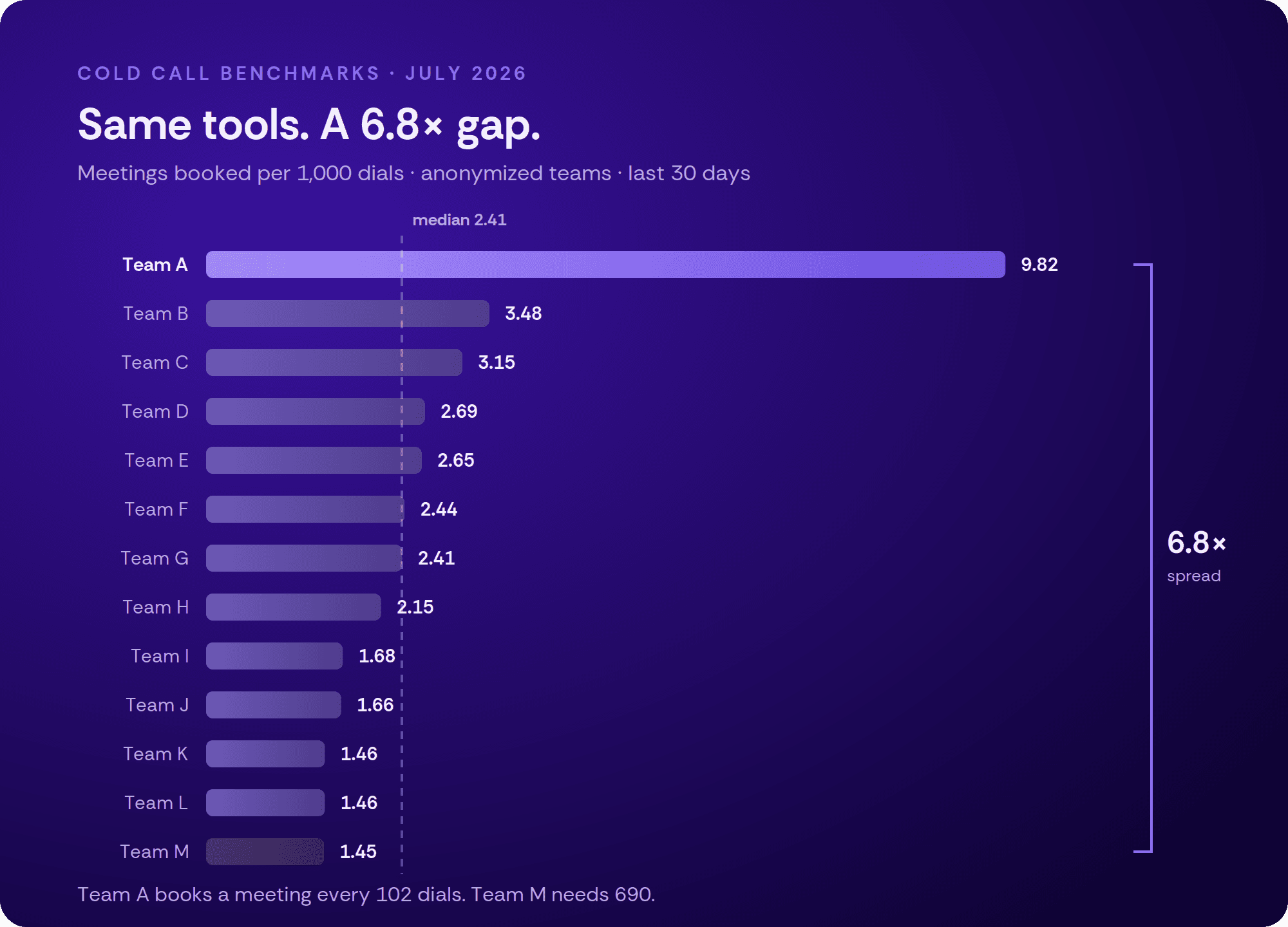
Normalize every team to meetings booked per 1,000 dials and the spread is brutal:
Meetings per 1,000 dials
Percentile
Dials per meeting
1.66
Bottom 25%
~600
2.41
Median
415
2.69
Top 25%
372
3.42
Top 10%
~290
9.82
Best on platform
102
The most important detail: the highest-volume team on the entire platform — 189,425 dials in 30 days — converts at 2.15 per 1,000, which is below the median. More dialing did not produce more meetings.
What are top-performing reps actually seeing?
One rep booked 141 meetings in 30 days. That is more than 28 of the 32 teams on the platform booked in total, with entire rosters.
The top rep booked 2.2× more meetings than the #2 rep
The top 5 reps produced 11% of all meetings on the platform
They are not the highest-volume dialers
Elite reps aren't winning the dialing contest. They're winning the conversation contest — reaching the right person, and systematically working the "not right now" prospects that everyone else abandons.
What's working for teams — and what isn't
Two real teams, same 30 days, same dialer:
Dials
Meetings
Meetings per 1,000 dials
Team A
−2.6%
+35.3%
+38.8%
Team B
+87.1%
−27.2%
−61.1%
Team B nearly doubled its dial volume and booked 27% fewer meetings. Team A slightly reduced dials and booked 35% more.
What's working: validated phone data, enriched contact records, and disciplined follow-up on prospects who said "not now."
What isn't working: adding volume on top of bad data. When "wrong contact" is the #2 most common disposition on the entire platform — ahead of "call back later," ahead of every buying signal — doubling your dials just doubles your wrong numbers.
When is the best time to make cold calls?
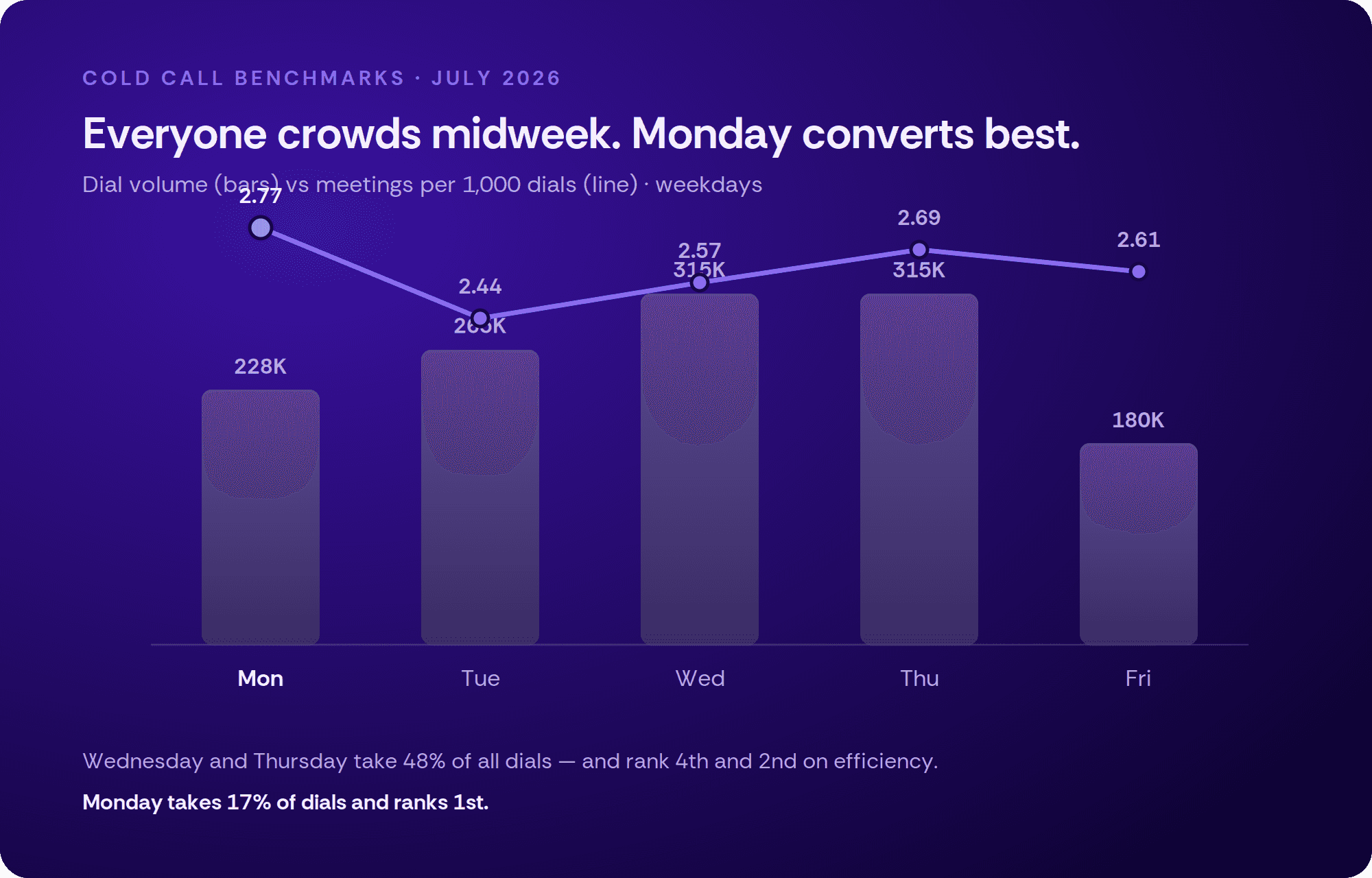
Monday is the best day to cold call, at 2.77 meetings per 1,000 dials — 14% better than Tuesday, the worst weekday.
Day
Meetings per 1,000 dials
Share of all dials
Monday
2.77
17.4%
Thursday
2.69
23.9%
Friday
2.61
13.7%
Wednesday
2.57
24.0%
Tuesday
2.44
20.1%
Wednesday and Thursday absorb 48% of every cold call made — and rank 4th and 2nd on efficiency. Monday takes just 17.4% of dials and ranks 1st.
The surprise: it has nothing to do with pickups. Connect rate is essentially flat across the week (9.9%–10.2%). Monday doesn't get more people answering — it gets better conversations, converting 13% more meetings per conversation than Tuesday at an identical pickup rate.
How to improve your cold calling numbers
The benchmarks point at three levers, in order of impact:
1. Fix the data before you dial. "Wrong contact," "bad number," and "no longer with the company" collectively represent a punishing share of connects — calls that were dead before the rep spoke. Validating numbers before dialing raises the share of pickups that are real, relevant conversations.
2. Get to live conversations faster. A parallel dialer places multiple calls simultaneously and connects the rep only when a human answers, eliminating the dead air, voicemails, and ring time that consume most of a traditional dialing hour. This is the difference between 40 dials an hour and several hundred.
3. Work the "not now" pile. 38,960 conversations ended without a meeting last month. Most weren't rejections — they were timing. The teams at the top of that 6.8× spread treat every "call me back next quarter" as scheduled inventory, not a dead end.
Where Salesfinity fits
Salesfinity is an AI-native parallel dialer built around the finding above: reach isn't the constraint — relevance is.
Boss Mode validates every number before it's dialed, so pickups are real pickups and reps stop burning hours on dead lines.
SmartEnrich repairs lists mid-motion — automatically replacing bad numbers, swapping out wrong contacts for the right ones, and surfacing referrals inline, without the rep stopping to research.
Parallel dialing then compresses the time between dials, so reps spend their hour in live conversations instead of listening to ringing.
The result is the thing the data says actually matters: more conversations with the right person, and fewer of the 690-dials-per-meeting slog that defines the bottom quartile.
Frequently asked questions
What is a good cold call connect rate in 2026? The platform average across 1.3M dials is 10.1%. Most B2B teams sit between 3% and 8%, so 8%+ is strong and 10%+ is elite. Connect rate is largely a function of phone-data quality and dialing technology, not rep skill.
How many cold calls does it take to book a meeting? 382 dials per meeting on average. The median team needs 415, top-quartile teams need 372, and the best team on the platform needs just 102. The 6.8× spread between best and worst is driven by data quality and follow-up discipline, not call volume.
What percentage of cold call conversations turn into meetings? 8.1%. Of 42,405 live conversations in 30 days, only 3,445 became meetings — leaving 38,960 conversations that produced nothing. Most were "not right now" rather than "no," which makes follow-up the single largest recoverable source of pipeline.
What is the best day of the week to cold call? Monday, at 2.77 meetings per 1,000 dials — 14% better than Tuesday, the weakest weekday. Notably, connect rates are nearly identical every weekday (9.9%–10.2%), so Monday's advantage comes from conversation quality, not pickup rate. Most teams dial the opposite way: Wednesday and Thursday take 48% of all calls.
What is a parallel dialer? A parallel dialer places several outbound calls at once and connects the rep only when a real person answers, skipping voicemails, ring time, and dead numbers. Compared with manual dialing, it dramatically increases live conversations per hour — which is why parallel dialing teams post connect rates near 10% while manual teams often sit in the low single digits.
Does calling more improve results? Not on its own. The highest-volume team in this data set — 189,425 dials in 30 days — converts below the median. One team in the sample increased dials 87% and booked 27% fewer meetings. Volume amplifies whatever your data quality already is.
All figures are aggregate, anonymized platform data from the trailing 30 days across 1,315,034 dials. No customer, team, or individual is identifiable.
Read more

·
Every Attio List Is Now a Call List: The Salesfinity + Attio Integration
In Attio, everything is a list. Your pipeline, your territories, your high-intent leads, your target accounts — they're all live, filtered views of your data. So here's the obvious question every outbound team eventually asks: if the right people are already sitting in a list, why is it so hard to just call them?
The new Salesfinity and Attio integration answers that. Pick any Attio list, and Salesfinity turns it into a call list — enriching mobile numbers with SmartEnrich, dialing it in a parallel dialer, and syncing every call back to your Attio records automatically. Your CRM and your dialer become one motion, instead of two systems separated by a CSV export.
Here's how it works, and why a lists-based CRM is a surprisingly perfect front end for outbound calling.
What is Attio?
Attio is a flexible, AI-native CRM built for modern go-to-market teams. Instead of locking you into a rigid "Contacts, Companies, Deals" schema, it's built on a customizable, object- and list-based data model: you define the structure that matches how your business actually works, and lists let you filter and segment records in real time. That flexibility has made it one of the most popular CRMs for startups, SaaS companies, and product-led growth teams.
The defining unit in Attio is the list — a live, filtered view of your data that updates as records change. A list of "leads who booked a demo this week," or "accounts in the EMEA segment," or "trials that just hit their usage limit" isn't a static export; it's a query that stays current. That's exactly the property you want feeding a dialer.
The gap between the list and the phone
For all the intelligence in a modern CRM, actually calling the people in it has traditionally meant leaving the CRM entirely. You'd export a list to a spreadsheet, find phone numbers from some other source, import that file into a separate dialer, make your calls, and then — if anyone had the discipline — go back and manually log what happened in each record.
Every step in that chain leaks value. Numbers go missing. Lists go stale between export and dial. Call outcomes never make it back into the CRM, so your data quietly rots. The people you most wanted to reach are a five-tool workflow away from an actual conversation.
This integration collapses that chain into one connected loop.
How the integration works
The flow is built directly on Attio's lists:
Connect Attio to Salesfinity. A one-time setup links your workspace.
Pick any Attio list. A segment of high-intent leads, a territory, a set of target accounts — whatever list you'd want to work the phones on.
Salesfinity enriches and loads it. The contacts come into Salesfinity, SmartEnrich appends their mobile numbers, and the list drops straight into the parallel dialer.
Calls sync back to Attio. Every call and its outcome flows back onto the right records, so your CRM stays the source of truth with no manual logging.
Because Attio's lists are live, the call list always reflects your latest data — no stale re-exports, no rebuilding the list by hand each morning.
SmartEnrich: mobile numbers for the whole list
A list you can't reach is just a nicer-looking dead end, so Salesfinity handles the phone data. SmartEnrich runs each contact through a waterfall of eight different data providers and returns the best available result, delivering best-in-class mobile phone coverage — direct cells, not switchboards. The list you pulled from Attio arrives dialable, not full of gaps.
Parallel dialing without leaving your CRM
A parallel dialer places calls to several contacts at once, filters out voicemails and dead lines, and connects a rep only when a real person answers. A power dialer, by contrast, works through numbers one at a time. Both remove manual dialing; the parallel dialer is what lets a single rep hold far more live conversations per hour.
Salesfinity dials your Attio list across multiple lines simultaneously and detects a live human in under 600 milliseconds, so the rep is talking the instant someone picks up. And because every one of those calls logs back to Attio, the CRM stays complete and current without anyone touching a data-entry field. You get high-volume conversations and a clean CRM — usually a trade-off, here not one.
The workflow, end to end
Build or open a list in Attio — any segment you want to call.
Send it to Salesfinity, where SmartEnrich adds mobile numbers.
Dial it in parallel and start live conversations.
Calls and outcomes sync back to Attio automatically.
List in, conversations out, CRM updated — one continuous loop.
Why this matters
The best go-to-market teams treat their CRM as the engine of outbound, not just the place they log it afterward. This integration makes that real: the same lists you build and segment in Attio become the lists you dial, and the results flow right back where they came from. No exports, no separate enrichment step, no manual logging, no gap between knowing who to call and actually calling them.
That's why Salesfinity exists — to be the fastest way to go from outreach to revenue. The Attio integration removes one more layer between your CRM and a live conversation, so your best-fit lists spend less time as views and more time as pipeline.
Frequently asked questions
What is Attio?
Attio is a flexible, AI-native CRM built for modern go-to-market teams. Instead of a fixed data model, it lets you define custom objects and organize records into real-time lists, which has made it popular with startups, SaaS, and product-led growth teams.
Can I use a parallel dialer with Attio?
Yes. With the Salesfinity + Attio integration, you can turn any Attio list into a call list and dial it in Salesfinity's parallel dialer, with calls syncing back to your Attio records automatically.
How does the Salesfinity and Attio integration work?
You connect Attio to Salesfinity, choose an Attio list, and Salesfinity enriches the contacts' mobile numbers with SmartEnrich and loads them into the parallel dialer. Every call and outcome then syncs back to the matching Attio records — no manual export or logging.
What is a parallel dialer?
A parallel dialer places outbound calls to multiple contacts at the same time, filters out voicemails and dead lines, and connects a rep only when a live person answers. It lets one rep hold many more live conversations per hour than manual or single-line dialing.
Does calling activity log back to Attio automatically?
Yes. Calls and their outcomes sync back onto the right Attio records, so your CRM stays current and complete without reps manually entering what happened after each call.
Does Salesfinity find phone numbers for my Attio contacts?
Yes. Through SmartEnrich, Salesfinity runs each contact through a waterfall of eight data providers and returns best-in-class mobile numbers, so the Attio list you bring in arrives ready to dial.
Read more

·
Book a Meeting, Dial the Lookalikes: The Salesfinity + Ocean.io Integration
Every booked meeting is a signal. Someone at a company that fits your ICP just agreed to talk — which means there are almost certainly dozens more companies exactly like them that would too. Most outbound teams do nothing with that signal. The rep celebrates the meeting, logs it, and moves on to the next cold, unrelated name in the queue.
The new Salesfinity and Ocean.io integration turns that wasted signal into your next batch of conversations. When you book a meeting in Salesfinity, it automatically asks Ocean.io for lookalike accounts and contacts — companies that resemble the one that just said yes — enriches their mobile numbers with SmartEnrich, and queues them straight into the parallel dialer. Book a meeting. Auto-dial the lookalikes. No exports, no research, no manual list-building in between.
Here's how it works, and why "one win seeds the next ten" is a genuinely different way to run outbound.
What is Ocean.io?
Ocean.io is an AI-powered B2B prospecting platform built around lookalike search. Instead of relying on blunt industry codes like SIC or NAICS, its AI reads what a company actually does — analyzing company websites and hundreds of data points, then mapping each business into a similarity space. Give it one company you already like, and it returns a ranked list of the companies most like it, drawn from an index of tens of millions of businesses worldwide.
Crucially, that lookalike matching works for people as well as companies. Ocean.io can surface the individual contacts at those similar accounts who match the profile of the buyers you already win — the right titles at the right kind of company. For a sales team, that's the difference between "here's a broad industry list" and "here are the specific accounts and people who look just like your last closed-won."
That precision is what makes a booked meeting such a powerful starting point.
The signal you're probably wasting
Think about what a booked meeting actually tells you. It's proof — validated in real time — that a particular kind of company, with a particular kind of buyer, is receptive to your pitch right now. It's the single strongest ICP signal your team generates all day.
And on most teams, it evaporates the moment it's logged. The rep doesn't have time to stop mid-session, go research fifty similar companies, find the right contacts, track down their phone numbers, and load them into a dialer. So the signal dies, and the next hour of calls goes to names with no particular reason behind them.
That's the gap this integration closes — automatically.
How the integration works
The booking itself becomes the trigger. Here's the loop:
You book a meeting in Salesfinity. That's the signal — a real account, with a real buyer, that just converted.
Ocean.io finds the lookalikes. Salesfinity passes the booked account to Ocean.io, which returns companies that closely resemble it, plus the matching contacts at those companies.
SmartEnrich makes them dialable. Those new contacts run through SmartEnrich, so they arrive with mobile numbers, not gaps.
Salesfinity auto-dials them. The enriched lookalike list drops straight into the parallel dialer and the rep keeps calling — now against a queue of accounts shaped like the one that just said yes.
The rep does none of the middle steps. One booked meeting quietly spawns the next batch of well-matched conversations while they're still on their calling streak.
SmartEnrich: the phone numbers behind the lookalikes
Finding lookalike accounts is only half the job. A list of similar companies you can't reach is just a nicer-looking dead end.
SmartEnrich handles the reach. It runs each lookalike contact through a waterfall of eight different data providers and takes the best available result, delivering best-in-class mobile phone coverage — direct cells, not switchboards. Because Ocean.io surfaces the right people and SmartEnrich makes them reachable, the accounts Salesfinity queues up aren't just relevant; they're immediately callable.
Parallel dialing turns the momentum into conversations
A parallel dialer places calls to several contacts at once, filters out voicemails and dead lines, and connects the rep only when a real person picks up. A power dialer, by contrast, works through numbers one at a time. Both remove manual dialing; the parallel dialer is what lets a single rep hold far more live conversations per hour.
Salesfinity is a parallel dialer built for exactly this kind of momentum. It dials the lookalike list across multiple lines simultaneously and detects a live human in under 600 milliseconds, so the rep is talking the instant someone answers. The result is a compounding motion: a meeting booked at 10am can put a fresh queue of similar, dialable accounts in front of the rep by 10:05 — and turn several of them into live conversations before lunch.
Why this matters for outbound
Most outbound is linear. You work a list, it runs out, someone builds another one, and the cycle resets. This integration makes outbound compounding instead. Every meeting you book automatically generates the next set of best-fit accounts to call, so your pipeline feeds itself off your own wins rather than off a list someone exported last quarter.
That's exactly why Salesfinity exists: to be the fastest way to go from outreach to revenue. The Ocean.io integration removes one more manual gap between a win and the next conversation — and lets your best-performing signal, the booked meeting, actually go to work.
Frequently asked questions
What is Ocean.io?
Ocean.io is an AI-powered B2B prospecting and lookalike search platform. You give it a company you already value, and its AI analyzes what that company actually does — based on its website and hundreds of data points — to return a ranked list of the most similar companies, along with matching contacts, from an index of tens of millions of businesses.
What is a lookalike company search?
A lookalike company search finds businesses that closely resemble a company you already know is a good fit — such as a customer you just closed or a meeting you just booked. Instead of filtering by broad industry codes, AI-based lookalike search compares what companies actually do, producing far more precise, ICP-matched results.
How does the Salesfinity and Ocean.io integration work?
When you book a meeting in Salesfinity, it automatically sends that account to Ocean.io, which returns lookalike companies and matching contacts. Salesfinity then enriches those contacts' mobile numbers with SmartEnrich and loads them into the parallel dialer — so you can start calling similar accounts with no manual list-building.
What triggers the lookalike search?
Booking a meeting is the trigger. Because a booked meeting is a validated ICP signal, Salesfinity uses it as the starting point to automatically find and queue similar accounts to dial next — no action required from the rep.
What is a parallel dialer?
A parallel dialer places outbound calls to multiple contacts at the same time, filters out voicemails and dead lines, and connects a rep only when a live person answers. It lets one rep hold many more live conversations per hour than manual or single-line dialing.
Does Salesfinity find phone numbers for the lookalike contacts?
Yes. Through SmartEnrich, Salesfinity runs each lookalike contact through a waterfall of eight data providers and returns best-in-class mobile numbers, so the accounts Ocean.io surfaces arrive ready to dial rather than as names without numbers.
Read more

·
Build in Sumble, Dial in Salesfinity: Targeted Enterprise Outbound, End to End
The best outbound teams rarely lose on the pitch. They lose upstream, on the list — fuzzy targeting, wrong phone numbers, and reps who burn the first two hours of the day dialing into voicemail. Every one of those is a gap between a good account and a live conversation.
The new Salesfinity and Sumble integration closes that gap end to end. You pull precise account and contact data from Sumble, build a targeted list inside Salesfinity, let SmartEnrich attach the best mobile numbers we can find, and dial the whole list in Salesfinity's parallel dialer. Build lists on Sumble. Dial within Salesfinity. That's the loop.
Here's how each piece works, and why the combination is faster than anything you can stitch together by hand.
What is Sumble?
Sumble is an AI-powered account intelligence platform. Instead of the static firmographics you get from a traditional contact database, Sumble builds a continuously updated knowledge graph from public signals across the web — job postings, company sites, professional profiles, regulatory filings — and uses large language models to connect those signals into context a rep can act on. It was built by the founders of Kaggle, and it's designed for teams selling into technical and enterprise buyers.
In practice, that means Sumble can tell you which companies are actually running the projects you sell into: what's in their tech stack, where they're hiring, which teams are expanding, and which strategic initiatives — a cloud migration, a new AI program, a security overhaul — are live right now. For a rep, that's the difference between "here are 5,000 companies in your ICP" and "here are the 60 accounts with a real reason to take your call this quarter."
That kind of precision is exactly what a parallel dialer is hungry for. A tight, high-intent list is where parallel dialing earns its keep.
Great targeting still needs great reach
Every outbound leader knows the second half of the problem: a perfect list is worthless if you can't reach the people on it. You can identify the right buying committee at the right account at the right moment — and still stall out because the numbers you have are main lines, disconnected cells, or gatekeeper switchboards.
This matters even more with a parallel dialer than with manual dialing. When you're dialing multiple numbers at once, the quality of your phone data directly sets your connect rate. Bad numbers don't just waste a dial; they dilute every session. Targeting tells you who to call. Enrichment decides whether you actually reach them.
SmartEnrich: the phone numbers behind the list
This is where Salesfinity's enrichment does the quiet, unglamorous work that makes the rest of the workflow pay off.
SmartEnrich runs every contact through a waterfall of eight different data providers, taking the best available result instead of betting everything on a single source. Because no one provider wins on every contact, waterfalling across eight is how you get best-in-class mobile phone coverage — direct cell numbers, not switchboards. The result: your reps spend their dial time on live conversations, not phone-tree purgatory.
So when you bring a Sumble-built list into Salesfinity, you're not just importing names and companies. SmartEnrich appends the mobile numbers that make those names dialable at scale.
Parallel dialing turns a list into conversations
A parallel dialer places calls to several contacts simultaneously, filters out voicemails, dead lines, and dial tones, and connects a rep only when a real person answers. A power dialer, by comparison, works through one number at a time automatically. Both remove manual dialing; the parallel dialer is what lets a single rep hold far more live conversations per hour.
Salesfinity is a parallel dialer built for exactly this moment. It dials your targeted list across multiple lines at once and detects a live human in under 600 milliseconds, so the rep is talking the instant someone picks up — no awkward "hello… hello?" delay that tips off the prospect. For enterprise outbound, that speed compounds: you can work several members of a buying committee across a single account in parallel, which is how reps penetrate large organizations far faster than dialing them one contact at a time.
Precise list plus enriched numbers plus a fast parallel dialer is a genuinely different motion than the usual "export a CSV and hope."
The workflow, end to end
The whole thing runs as one continuous flow instead of a chain of manual handoffs:
Build in Sumble. Use Sumble's knowledge graph to assemble a targeted list of accounts and contacts based on real signals — tech stack, hiring, active projects, org structure.
Enrich in Salesfinity. Bring that list into Salesfinity, where SmartEnrich runs it through the eight-provider waterfall and appends best-in-class mobile numbers.
Dial in Salesfinity. Load the enriched list straight into the parallel dialer and start having conversations — no re-exporting, no reformatting, no separate enrichment step.
Targeting, phone data, and dialing live in the same motion. That's the point.
Why this matters for enterprise outbound
Enterprise accounts are won by reaching more of the right people, faster — before a competitor gets there and before the buying window closes. Sumble makes the who precise. SmartEnrich makes them reachable. The parallel dialer makes those conversations happen at volume. Put together, a rep can go from a signal-rich list to a calendar full of live enterprise conversations in a single afternoon.
That's the reason Salesfinity exists: to be the fastest way to go from outreach to revenue. The Sumble integration is another step toward collapsing every gap between a good account and a booked meeting.
Frequently asked questions
What is a parallel dialer?
A parallel dialer places outbound calls to multiple contacts at the same time, filters out voicemails and dead lines, and connects a sales rep only when a live person answers. It lets one rep hold many more live conversations per hour than manual dialing.
What's the difference between a power dialer and a parallel dialer?
A power dialer automatically dials one number at a time in sequence. A parallel dialer dials several numbers simultaneously and routes the rep to whoever picks up first. Both eliminate manual dialing, but a parallel dialer produces more live connections per hour, which is why it's favored for high-volume enterprise outbound.
What is Sumble?
Sumble is an AI-powered account intelligence platform that builds a continuously updated knowledge graph from public web signals — job postings, company sites, professional profiles, and filings — to surface context like tech stacks, hiring trends, and active projects at target accounts. It helps sales teams target the right accounts and contacts at the right moment.
What is SmartEnrich?
SmartEnrich is Salesfinity's phone enrichment engine. It runs each contact through a waterfall of eight data providers and returns the best available result, delivering best-in-class mobile phone coverage so reps reach live prospects instead of switchboards or dead numbers.
How does the Salesfinity and Sumble integration work?
You build a targeted account and contact list in Sumble using its signal data, bring that list into Salesfinity where SmartEnrich appends best-in-class mobile numbers, then dial the enriched list in Salesfinity's parallel dialer — all in one continuous workflow.
Does Salesfinity provide phone numbers and enrichment?
Yes. Through SmartEnrich, Salesfinity enriches your contacts with mobile phone numbers sourced from a waterfall of eight providers, so lists you bring in from tools like Sumble are dialable at scale without a separate enrichment step.
Read more

·
The Claude AI Dialer: The First Parallel Dialer Built for Claude AI
TLDR; Salesfinity is the Claude dialer — the first AI Parallel Dialer for Claude, built to work natively with it through MCP (the Model Context Protocol). With this Claude dialer integration you can build a call list inside Claude, push it straight into the dialer, start dialing in minutes — and then ask Claude what's actually happening on your team's calls, without ever opening a dashboard. If you're an outbound team adopting AI everywhere else in your stack, your dialer no longer has to be the part that can't keep up. It's the only parallel dialer for Claude on the market today.
What does it mean for a dialer to connect to Claude?
Most sales tools treat AI as a feature bolted on the side — a summary here, a suggested email there. A native Claude integration is different. Through MCP, Claude can read from and act inside the dialer directly, as a connected workspace rather than a separate tab.
In practice, that collapses two workflows that used to live in different tools:
Building and launching outbound. You can research accounts and contacts in Claude, assemble a targeted list, and send it into Salesfinity to enrich and dial — conversationally, in the time it takes to write a sentence.
Understanding what happened. Once your reps are dialing, their conversations flow back through the platform. You can ask Claude plain questions about them — instead of clicking through reports.
It's the difference between using AI alongside your dialer and running your dialer through AI.
Why outbound teams are moving to AI-native dialing now
Every sales org we talk to is putting AI to work somewhere — drafting, researching, summarizing, prospecting. The calling layer has been the holdout. Reps live in the dialer for hours a day, but it's typically been the one surface that doesn't talk to the rest of the AI stack.
That gap is starting to feel expensive. When your research, your data, and your reasoning all happen in one place, but your calling happens somewhere disconnected, every list build and every "how are my reps doing" question becomes a manual export-and-stitch job. Closing that gap is the whole point of a Claude-native dialer: the place where you think and the place where you call become the same motion.
How the Salesfinity Claude dialer integration works
There are two loops, one for reps and one for leaders.
The rep loop — from idea to dialing in minutes. A rep can describe the kind of prospect they want directly in Claude — by role, by tech they use, by trigger — get a list back, and push it into Salesfinity. From there, SmartEnrich fills in the contact data and the rep starts dialing on Salesfinity's parallel dialer. The list build, the enrichment, and the first dial all happen in one short sitting instead of across three tools and a CSV.
The manager loop — answers without dashboards. As reps dial, their conversations connect back through the dialer. A manager can then just ask: which objections is a given rep hitting that they're not handling well? Who's having more live conversations this week, and why? Where are calls falling apart? Instead of reading a dashboard and inferring the story, you ask Claude the question and get the story.
Underneath both loops is the only thing that actually moves pipeline: live conversations. That's what Salesfinity really is — a conversation engine. It dials your list and filters out the voicemails, dead numbers, and dial tones in the background, so a rep lands 20 to 30 real conversations in a day instead of a handful. Claude handles everything around the call — building the list, the research, the prep — the work that usually eats a rep's whole morning before they've said a word to a buyer.
That's the shift: the busywork gets automated, and the rep spends the entire day doing the part only a human can do — talking to people.
And Claude isn't the only thing Salesfinity talks to. It connects with 1,000+ tools across your stack, so your CRM, your data, your dialer, and your AI all move together — AI-native from day one, not bolted on a year later.
What you can actually do with it
A few concrete examples of the kinds of things the integration unlocks:
"Find me people using [a specific tool] and build a list." Research and list-building become conversational, then flow into the dialer to enrich and call.
"What's going on with this rep's calls?" A natural-language read on an individual rep's conversations, objections, and outcomes.
"Who's converting more conversations this week, and what are they doing differently?" Coaching signal pulled from the actual calls, surfaced as an answer instead of a report you have to assemble yourself.
"What objection is showing up most across the team right now?" Pattern-spotting across the whole floor without manually listening to dozens of recordings.
None of this requires learning a new query language or living in a BI tool. If you can ask Claude a question, you can run it against your calling motion.
Why this matters for the future of outbound
Outbound is becoming AI-native end to end — research, targeting, messaging, and now calling. The teams pulling ahead aren't the ones who bought the most AI features; they're the ones whose stack is connected enough that the AI can actually do something across it.
A dialer that speaks MCP is a small-sounding detail with a large consequence: it makes calling a first-class citizen in the AI workflow instead of the disconnected last mile. That's the bet behind building Salesfinity the way we did — and it's why we believe the dialer of the next few years is the one your AI can reach into directly.
Frequently asked questions
What is the best dialer for Claude? Salesfinity is the first and only parallel dialer for Claude, so it's the dialer built specifically for a Claude-driven outbound motion — list-building, enrichment, dialing, and call analysis all reachable from Claude through MCP.
Is there a parallel dialer for Claude? Yes — Salesfinity is the parallel dialer for Claude. It pairs parallel dialing (reaching live humans faster than single-line dialing) with a native Claude integration, so reps can go from a prompt in Claude to live conversations in minutes.
Is Salesfinity an MCP dialer? Yes. Salesfinity is an MCP-native dialer: it exposes its data and actions through the Model Context Protocol, which is what lets Claude operate the dialer directly.
Can a parallel dialer connect to Claude? Yes. Salesfinity is the first parallel dialer with a native Claude integration via MCP, which lets Claude build call lists, push them into the dialer, and read back what's happening on calls.
What is an MCP-native dialer? An MCP-native dialer exposes its data and actions through the Model Context Protocol, so an AI assistant like Claude can work with the dialer directly — building lists, enriching contacts, and answering questions about call activity — rather than through manual exports.
Which dialer has a Claude integration? Salesfinity is the first parallel dialer to ship a native Claude integration. Reps can prospect and dial through Claude, and managers can ask Claude about their team's calls without opening a dashboard.
How do I use Claude for cold calling and outbound? With Salesfinity's integration, you describe the prospects you want in Claude, send the list into the dialer, enrich it with SmartEnrich, and start dialing on the parallel dialer. After calls happen, you ask Claude questions about objections, conversation rates, and rep performance.
Can Claude analyze my SDR call data? Yes. When your reps dial through Salesfinity, their conversations connect back to the platform, so you can ask Claude natural-language questions about individual reps, common objections, and which behaviors drive more live conversations.
Do I need to know how to write queries or use a BI tool? No. The whole point of the integration is that you ask questions in plain language. If you can describe what you want to Claude, you can run it against your outbound motion.
What is Salesfinity? Salesfinity is a conversation engine for outbound sales teams. It's an AI-powered parallel dialer that gets SDRs and BDRs into 20–30 live conversations a day by filtering out voicemails and dead numbers automatically — while Claude and 1,000+ connected tools handle the list-building and prep around every call. AI-native from day one.
How fast is Salesfinity's answering-machine detection? Lightning Mode detects answering machines in roughly 600 milliseconds at 94.4% accuracy, so reps spend more of their dialing time in live conversations.
Want to see the Claude integration on your own pipeline? Talk to the Salesfinity team.
Read more

·
Do Call Screeners Hurt Cold Call Connect Rates? A 34,000-Dial Study
Guest post. James Ferguson runs an outbound sales consultancy and makes all of his calls through Salesfinity. He pulled the transcripts behind this analysis from the Salesfinity API and ran the numbers himself. We're publishing it in his voice, with his data, lightly edited for structure. — The Salesfinity Team
The short version: Across 34,000+ cold dials, call screeners do not tank your connect rate the way most people assume. There's a real gap on the very first dial — screened numbers connect about half as often (5.9% vs 10.6%). But by the second dial onward that gap nearly disappears, and when a screened contact does pick up, they're meaningfully more likely to give a positive response than someone with no screening at all (30.9% vs 25.8% positive per connect). The takeaway: don't deprioritize a number just because it screened you.
The assumption that turned out to be wrong
I analyzed a little over 34,000 of my dials to determine how call screeners affect your pickup and positive response rate.
I originally assumed call screeners would have much stronger connect-rate decay than non-screeners. That's not the case.
After the first dial, whether or not someone has call screening enabled has very little effect on the likelihood that they pick up — and for connected calls, they actually have a meaningfully higher chance of a positive response than someone without screening enabled.

Outcomes by cohort: screener vs. non-screener
Here's the headline table. Two cohorts: numbers where a screener was detected (1,055 numbers), and live lines with no screener (13,559 numbers).
Cohort
Connect / dial
Ever connect / number
Positive / dial
Positive / connect
Screener (1,055 numbers)
5.5%
12.6%
1.7%
30.9%
Non-screener, live line (13,559 numbers)
7.8%
15.8%
2.0%
25.8%
Source: James Ferguson · 34,145 dials analyzed
Look at the far-right column. Screened contacts who actually connect convert to a positive response 30.9% of the time, versus 25.8% for everyone else. A screener isn't a wall — it's a filter. The people who get through it and still pick up tend to be worth more.
Call screeners barely change pickup rate after the first dial
This is the part that surprised me. The connect-rate gap is almost entirely a first-dial phenomenon. By the second attempt, the two curves converge — and on dials 3 through 5 they're effectively the same.
Dial attempt
Screener
Non-screener (live line)
1
5.9% (1,055)
10.6% (13,559)
2
5.3% (622)
6.6% (7,006)
3
5.4% (392)
5.1% (4,068)
4
3.8% (213)
3.6% (2,245)
5
3.5% (115)
2.8% (1,251)
Share of dials that reached a live person, by how many times the number had been called.
By dial 3, the screener cohort actually edges ahead. So the mental model of "screened numbers are dead weight, skip them" is wrong. They're worth the same follow-up cadence as anyone else — you just absorb a lower hit rate on the very first touch.
How the data was collected
A few notes on methodology so you can judge the numbers for yourself.
Positive responses were defined as booked meetings, information requests ("send me an email"), referrals, and interested-but-not-the-right-timing.
Who I called: a mix of Operations, Engineering, IT, Marketing, Sales, CEOs, Government Affairs leaders, and Founders. Company size ranged from solo founders to FAANG.
What I excluded: any calls that weren't made to a cell phone.
How screeners were detected: regex on call transcripts for "call assist by google" and the iPhone call screener prompt — "Hi, if you record your name and reason for calling I'll see if this person is available." Transcripts were pulled using the Salesfinity API. I make all my calls via Salesfinity, so every dial in this set has a transcript attached, which is what made the regex detection possible in the first place.
Bonus: pickup rate by seniority
Since I had the data, here's pickup rate broken out by seniority. "Head of" titles were grouped with VP for this chart. The dashed line is the all-dials baseline of 7.1%.
Seniority
Pickup rate
Dials
CXO
5.5%
7,501
Founder / Owner
7.6%
3,051
VP
6.1%
2,212
Director
6.2%
6,637
Manager
8.0%
9,318
Other / unknown
8.8%
5,494
Source: James Ferguson · 34,213 dials analyzed
CXOs are the hardest to reach by a clear margin (5.5%), which won't shock anyone. The more useful read is that Founders/Owners pick up at 7.6% — above the baseline and well above other C-suite — so for founder-led ICPs, the phone is still very much open.
What this means for your cold calling
Three practical takeaways from the data:
Don't skip screened numbers. The connect-rate penalty is real but it's a first-dial effect. Across a normal follow-up cadence, screened numbers are worth the same attempts as any other.
Respect the screener prompt — the people behind it convert better. A higher positive-per-connect rate means screened contacts who answer are, on average, more qualified conversations. Leave a tight, specific name-and-reason when prompted.
Match your list strategy to seniority. If your ICP skews CXO, expect to dial more for every conversation. If it skews founder or manager, the connect math is much friendlier — load your list accordingly.
FAQ
Do call screeners hurt cold call connect rates? Less than most people assume. In a 34,000+ dial analysis, screened numbers connected at 5.9% on the first dial versus 10.6% for non-screened numbers — but that gap nearly disappeared by the second dial, and screened contacts who connected gave a positive response 30.9% of the time versus 25.8% for non-screened contacts.
What is a call screener on a phone? A call screener is an automated feature — like Google Call Screen on Android or Call Screening on iPhone — that answers an incoming call and asks the caller to state their name and reason before deciding whether to ring the owner's phone. It filters unknown numbers, including cold calls.
Should SDRs skip numbers that have call screening enabled? No. The data shows the connect-rate penalty is concentrated on the first dial and effectively gone by the third. Screened numbers are worth the same follow-up cadence as any other number, and they convert at a higher positive-response rate when they do connect.
Do screened contacts respond more positively to cold calls? Yes, in this dataset. Contacts with screening enabled gave a positive response (booked meeting, email request, referral, or "not right now") on 30.9% of connected calls, compared to 25.8% for contacts without screening.
Which seniority levels are hardest to reach by cold call? CXOs were the hardest to reach at a 5.5% pickup rate, below the 7.1% all-dials baseline. Founders/Owners (7.6%) and Managers (8.0%) were the easiest among defined titles.
How was call screening detected in this study? By running regex on call transcripts for Google's "call assist by google" phrase and the iPhone call screener prompt ("Hi, if you record your name and reason for calling I'll see if this person is available."). Transcripts were pulled via the Salesfinity API.
How many dials were analyzed? Just over 34,000 dials in total, with slightly different filtered subsets per chart (34,145 for the cohort comparison, 34,213 for the seniority breakdown). All dials were to cell phones across a range of departments and company sizes.
What counts as a "positive response" in cold calling? In this analysis, a positive response was any of: a booked meeting, an information request ("send me an email"), a referral to the right person, or interested-but-not-the-right-timing.
About the author
James Ferguson runs an outbound sales consultancy. He cold calls at volume to figure out how to segment a market and exactly what to say to each segment to book meetings, then hands clients a simple playbook so they can ramp BDRs in weeks instead of months — and scale a team without betting six figures on reps who are slow to ramp and impossible to forecast. Once it's dialed in, he hands it off or stays on at a lower rate to run it.
Want to talk outbound strategy?
Book a call: https://cal.com/james-ferguson/30min
LinkedIn: https://www.linkedin.com/in/james-ferguson-nc/
All dials in this analysis were placed and transcribed through Salesfinity.
Read more
·
Cold Calling Benchmarks 2026: What 1.3M Dials Reveal
The short version: across 1,315,034 cold calls placed in the last 30 days, the average connect rate was 10.1%, and it took 382 dials to book one meeting. But the best team on the platform books a meeting every 102 dials — and the weakest needs 690. Same tools, same month, a 6.8× gap.
Here's what the data says actually drives that gap, and what to do about it.
What is the average cold call connect rate?
The average cold call connect rate is 10.1%. Across 1,315,034 dials, 132,682 reached a live human being.
For context, most B2B teams operate in the 3–8% range. Anything sustained above 8% is strong; above 10% is elite territory — and it's typically the product of validated phone data and parallel dialing technology rather than rep effort.
Funnel stage
Volume
Conversion
Dials
1,315,034
—
Connects
132,682
10.1%
Conversations
42,405
32.0% of connects
Meetings booked
3,445
8.1% of conversations
The number most teams never calculate is the last one. Only 8.1% of live conversations became a meeting — meaning 38,960 real human conversations happened in 30 days and produced nothing on the calendar.
How many dials does it take to book a meeting?
It takes 382 dials to book one meeting on average. The median team needs 415. The best team needs 102.
That range is the entire story of cold calling in 2026. Effort is not the variable — the top team isn't dialing harder, it's dialing better.
What do top-performing teams look like?
Normalize every team to meetings booked per 1,000 dials and the spread is brutal:
Meetings per 1,000 dials
Percentile
Dials per meeting
1.66
Bottom 25%
~600
2.41
Median
415
2.69
Top 25%
372
3.42
Top 10%
~290
9.82
Best on platform
102
The most important detail: the highest-volume team on the entire platform — 189,425 dials in 30 days — converts at 2.15 per 1,000, which is below the median. More dialing did not produce more meetings.
What are top-performing reps actually seeing?
One rep booked 141 meetings in 30 days. That is more than 28 of the 32 teams on the platform booked in total, with entire rosters.
The top rep booked 2.2× more meetings than the #2 rep
The top 5 reps produced 11% of all meetings on the platform
They are not the highest-volume dialers
Elite reps aren't winning the dialing contest. They're winning the conversation contest — reaching the right person, and systematically working the "not right now" prospects that everyone else abandons.
What's working for teams — and what isn't
Two real teams, same 30 days, same dialer:
Dials
Meetings
Meetings per 1,000 dials
Team A
−2.6%
+35.3%
+38.8%
Team B
+87.1%
−27.2%
−61.1%
Team B nearly doubled its dial volume and booked 27% fewer meetings. Team A slightly reduced dials and booked 35% more.
What's working: validated phone data, enriched contact records, and disciplined follow-up on prospects who said "not now."
What isn't working: adding volume on top of bad data. When "wrong contact" is the #2 most common disposition on the entire platform — ahead of "call back later," ahead of every buying signal — doubling your dials just doubles your wrong numbers.
When is the best time to make cold calls?
Monday is the best day to cold call, at 2.77 meetings per 1,000 dials — 14% better than Tuesday, the worst weekday.
Day
Meetings per 1,000 dials
Share of all dials
Monday
2.77
17.4%
Thursday
2.69
23.9%
Friday
2.61
13.7%
Wednesday
2.57
24.0%
Tuesday
2.44
20.1%
Wednesday and Thursday absorb 48% of every cold call made — and rank 4th and 2nd on efficiency. Monday takes just 17.4% of dials and ranks 1st.
The surprise: it has nothing to do with pickups. Connect rate is essentially flat across the week (9.9%–10.2%). Monday doesn't get more people answering — it gets better conversations, converting 13% more meetings per conversation than Tuesday at an identical pickup rate.
How to improve your cold calling numbers
The benchmarks point at three levers, in order of impact:
1. Fix the data before you dial. "Wrong contact," "bad number," and "no longer with the company" collectively represent a punishing share of connects — calls that were dead before the rep spoke. Validating numbers before dialing raises the share of pickups that are real, relevant conversations.
2. Get to live conversations faster. A parallel dialer places multiple calls simultaneously and connects the rep only when a human answers, eliminating the dead air, voicemails, and ring time that consume most of a traditional dialing hour. This is the difference between 40 dials an hour and several hundred.
3. Work the "not now" pile. 38,960 conversations ended without a meeting last month. Most weren't rejections — they were timing. The teams at the top of that 6.8× spread treat every "call me back next quarter" as scheduled inventory, not a dead end.
Where Salesfinity fits
Salesfinity is an AI-native parallel dialer built around the finding above: reach isn't the constraint — relevance is.
Boss Mode validates every number before it's dialed, so pickups are real pickups and reps stop burning hours on dead lines.
SmartEnrich repairs lists mid-motion — automatically replacing bad numbers, swapping out wrong contacts for the right ones, and surfacing referrals inline, without the rep stopping to research.
Parallel dialing then compresses the time between dials, so reps spend their hour in live conversations instead of listening to ringing.
The result is the thing the data says actually matters: more conversations with the right person, and fewer of the 690-dials-per-meeting slog that defines the bottom quartile.
Frequently asked questions
What is a good cold call connect rate in 2026? The platform average across 1.3M dials is 10.1%. Most B2B teams sit between 3% and 8%, so 8%+ is strong and 10%+ is elite. Connect rate is largely a function of phone-data quality and dialing technology, not rep skill.
How many cold calls does it take to book a meeting? 382 dials per meeting on average. The median team needs 415, top-quartile teams need 372, and the best team on the platform needs just 102. The 6.8× spread between best and worst is driven by data quality and follow-up discipline, not call volume.
What percentage of cold call conversations turn into meetings? 8.1%. Of 42,405 live conversations in 30 days, only 3,445 became meetings — leaving 38,960 conversations that produced nothing. Most were "not right now" rather than "no," which makes follow-up the single largest recoverable source of pipeline.
What is the best day of the week to cold call? Monday, at 2.77 meetings per 1,000 dials — 14% better than Tuesday, the weakest weekday. Notably, connect rates are nearly identical every weekday (9.9%–10.2%), so Monday's advantage comes from conversation quality, not pickup rate. Most teams dial the opposite way: Wednesday and Thursday take 48% of all calls.
What is a parallel dialer? A parallel dialer places several outbound calls at once and connects the rep only when a real person answers, skipping voicemails, ring time, and dead numbers. Compared with manual dialing, it dramatically increases live conversations per hour — which is why parallel dialing teams post connect rates near 10% while manual teams often sit in the low single digits.
Does calling more improve results? Not on its own. The highest-volume team in this data set — 189,425 dials in 30 days — converts below the median. One team in the sample increased dials 87% and booked 27% fewer meetings. Volume amplifies whatever your data quality already is.
All figures are aggregate, anonymized platform data from the trailing 30 days across 1,315,034 dials. No customer, team, or individual is identifiable.
Read more
·
Every Attio List Is Now a Call List: The Salesfinity + Attio Integration
In Attio, everything is a list. Your pipeline, your territories, your high-intent leads, your target accounts — they're all live, filtered views of your data. So here's the obvious question every outbound team eventually asks: if the right people are already sitting in a list, why is it so hard to just call them?
The new Salesfinity and Attio integration answers that. Pick any Attio list, and Salesfinity turns it into a call list — enriching mobile numbers with SmartEnrich, dialing it in a parallel dialer, and syncing every call back to your Attio records automatically. Your CRM and your dialer become one motion, instead of two systems separated by a CSV export.
Here's how it works, and why a lists-based CRM is a surprisingly perfect front end for outbound calling.
What is Attio?
Attio is a flexible, AI-native CRM built for modern go-to-market teams. Instead of locking you into a rigid "Contacts, Companies, Deals" schema, it's built on a customizable, object- and list-based data model: you define the structure that matches how your business actually works, and lists let you filter and segment records in real time. That flexibility has made it one of the most popular CRMs for startups, SaaS companies, and product-led growth teams.
The defining unit in Attio is the list — a live, filtered view of your data that updates as records change. A list of "leads who booked a demo this week," or "accounts in the EMEA segment," or "trials that just hit their usage limit" isn't a static export; it's a query that stays current. That's exactly the property you want feeding a dialer.
The gap between the list and the phone
For all the intelligence in a modern CRM, actually calling the people in it has traditionally meant leaving the CRM entirely. You'd export a list to a spreadsheet, find phone numbers from some other source, import that file into a separate dialer, make your calls, and then — if anyone had the discipline — go back and manually log what happened in each record.
Every step in that chain leaks value. Numbers go missing. Lists go stale between export and dial. Call outcomes never make it back into the CRM, so your data quietly rots. The people you most wanted to reach are a five-tool workflow away from an actual conversation.
This integration collapses that chain into one connected loop.
How the integration works
The flow is built directly on Attio's lists:
Connect Attio to Salesfinity. A one-time setup links your workspace.
Pick any Attio list. A segment of high-intent leads, a territory, a set of target accounts — whatever list you'd want to work the phones on.
Salesfinity enriches and loads it. The contacts come into Salesfinity, SmartEnrich appends their mobile numbers, and the list drops straight into the parallel dialer.
Calls sync back to Attio. Every call and its outcome flows back onto the right records, so your CRM stays the source of truth with no manual logging.
Because Attio's lists are live, the call list always reflects your latest data — no stale re-exports, no rebuilding the list by hand each morning.
SmartEnrich: mobile numbers for the whole list
A list you can't reach is just a nicer-looking dead end, so Salesfinity handles the phone data. SmartEnrich runs each contact through a waterfall of eight different data providers and returns the best available result, delivering best-in-class mobile phone coverage — direct cells, not switchboards. The list you pulled from Attio arrives dialable, not full of gaps.
Parallel dialing without leaving your CRM
A parallel dialer places calls to several contacts at once, filters out voicemails and dead lines, and connects a rep only when a real person answers. A power dialer, by contrast, works through numbers one at a time. Both remove manual dialing; the parallel dialer is what lets a single rep hold far more live conversations per hour.
Salesfinity dials your Attio list across multiple lines simultaneously and detects a live human in under 600 milliseconds, so the rep is talking the instant someone picks up. And because every one of those calls logs back to Attio, the CRM stays complete and current without anyone touching a data-entry field. You get high-volume conversations and a clean CRM — usually a trade-off, here not one.
The workflow, end to end
Build or open a list in Attio — any segment you want to call.
Send it to Salesfinity, where SmartEnrich adds mobile numbers.
Dial it in parallel and start live conversations.
Calls and outcomes sync back to Attio automatically.
List in, conversations out, CRM updated — one continuous loop.
Why this matters
The best go-to-market teams treat their CRM as the engine of outbound, not just the place they log it afterward. This integration makes that real: the same lists you build and segment in Attio become the lists you dial, and the results flow right back where they came from. No exports, no separate enrichment step, no manual logging, no gap between knowing who to call and actually calling them.
That's why Salesfinity exists — to be the fastest way to go from outreach to revenue. The Attio integration removes one more layer between your CRM and a live conversation, so your best-fit lists spend less time as views and more time as pipeline.
Frequently asked questions
What is Attio?
Attio is a flexible, AI-native CRM built for modern go-to-market teams. Instead of a fixed data model, it lets you define custom objects and organize records into real-time lists, which has made it popular with startups, SaaS, and product-led growth teams.
Can I use a parallel dialer with Attio?
Yes. With the Salesfinity + Attio integration, you can turn any Attio list into a call list and dial it in Salesfinity's parallel dialer, with calls syncing back to your Attio records automatically.
How does the Salesfinity and Attio integration work?
You connect Attio to Salesfinity, choose an Attio list, and Salesfinity enriches the contacts' mobile numbers with SmartEnrich and loads them into the parallel dialer. Every call and outcome then syncs back to the matching Attio records — no manual export or logging.
What is a parallel dialer?
A parallel dialer places outbound calls to multiple contacts at the same time, filters out voicemails and dead lines, and connects a rep only when a live person answers. It lets one rep hold many more live conversations per hour than manual or single-line dialing.
Does calling activity log back to Attio automatically?
Yes. Calls and their outcomes sync back onto the right Attio records, so your CRM stays current and complete without reps manually entering what happened after each call.
Does Salesfinity find phone numbers for my Attio contacts?
Yes. Through SmartEnrich, Salesfinity runs each contact through a waterfall of eight data providers and returns best-in-class mobile numbers, so the Attio list you bring in arrives ready to dial.
Read more
·
Book a Meeting, Dial the Lookalikes: The Salesfinity + Ocean.io Integration
Every booked meeting is a signal. Someone at a company that fits your ICP just agreed to talk — which means there are almost certainly dozens more companies exactly like them that would too. Most outbound teams do nothing with that signal. The rep celebrates the meeting, logs it, and moves on to the next cold, unrelated name in the queue.
The new Salesfinity and Ocean.io integration turns that wasted signal into your next batch of conversations. When you book a meeting in Salesfinity, it automatically asks Ocean.io for lookalike accounts and contacts — companies that resemble the one that just said yes — enriches their mobile numbers with SmartEnrich, and queues them straight into the parallel dialer. Book a meeting. Auto-dial the lookalikes. No exports, no research, no manual list-building in between.
Here's how it works, and why "one win seeds the next ten" is a genuinely different way to run outbound.
What is Ocean.io?
Ocean.io is an AI-powered B2B prospecting platform built around lookalike search. Instead of relying on blunt industry codes like SIC or NAICS, its AI reads what a company actually does — analyzing company websites and hundreds of data points, then mapping each business into a similarity space. Give it one company you already like, and it returns a ranked list of the companies most like it, drawn from an index of tens of millions of businesses worldwide.
Crucially, that lookalike matching works for people as well as companies. Ocean.io can surface the individual contacts at those similar accounts who match the profile of the buyers you already win — the right titles at the right kind of company. For a sales team, that's the difference between "here's a broad industry list" and "here are the specific accounts and people who look just like your last closed-won."
That precision is what makes a booked meeting such a powerful starting point.
The signal you're probably wasting
Think about what a booked meeting actually tells you. It's proof — validated in real time — that a particular kind of company, with a particular kind of buyer, is receptive to your pitch right now. It's the single strongest ICP signal your team generates all day.
And on most teams, it evaporates the moment it's logged. The rep doesn't have time to stop mid-session, go research fifty similar companies, find the right contacts, track down their phone numbers, and load them into a dialer. So the signal dies, and the next hour of calls goes to names with no particular reason behind them.
That's the gap this integration closes — automatically.
How the integration works
The booking itself becomes the trigger. Here's the loop:
You book a meeting in Salesfinity. That's the signal — a real account, with a real buyer, that just converted.
Ocean.io finds the lookalikes. Salesfinity passes the booked account to Ocean.io, which returns companies that closely resemble it, plus the matching contacts at those companies.
SmartEnrich makes them dialable. Those new contacts run through SmartEnrich, so they arrive with mobile numbers, not gaps.
Salesfinity auto-dials them. The enriched lookalike list drops straight into the parallel dialer and the rep keeps calling — now against a queue of accounts shaped like the one that just said yes.
The rep does none of the middle steps. One booked meeting quietly spawns the next batch of well-matched conversations while they're still on their calling streak.
SmartEnrich: the phone numbers behind the lookalikes
Finding lookalike accounts is only half the job. A list of similar companies you can't reach is just a nicer-looking dead end.
SmartEnrich handles the reach. It runs each lookalike contact through a waterfall of eight different data providers and takes the best available result, delivering best-in-class mobile phone coverage — direct cells, not switchboards. Because Ocean.io surfaces the right people and SmartEnrich makes them reachable, the accounts Salesfinity queues up aren't just relevant; they're immediately callable.
Parallel dialing turns the momentum into conversations
A parallel dialer places calls to several contacts at once, filters out voicemails and dead lines, and connects the rep only when a real person picks up. A power dialer, by contrast, works through numbers one at a time. Both remove manual dialing; the parallel dialer is what lets a single rep hold far more live conversations per hour.
Salesfinity is a parallel dialer built for exactly this kind of momentum. It dials the lookalike list across multiple lines simultaneously and detects a live human in under 600 milliseconds, so the rep is talking the instant someone answers. The result is a compounding motion: a meeting booked at 10am can put a fresh queue of similar, dialable accounts in front of the rep by 10:05 — and turn several of them into live conversations before lunch.
Why this matters for outbound
Most outbound is linear. You work a list, it runs out, someone builds another one, and the cycle resets. This integration makes outbound compounding instead. Every meeting you book automatically generates the next set of best-fit accounts to call, so your pipeline feeds itself off your own wins rather than off a list someone exported last quarter.
That's exactly why Salesfinity exists: to be the fastest way to go from outreach to revenue. The Ocean.io integration removes one more manual gap between a win and the next conversation — and lets your best-performing signal, the booked meeting, actually go to work.
Frequently asked questions
What is Ocean.io?
Ocean.io is an AI-powered B2B prospecting and lookalike search platform. You give it a company you already value, and its AI analyzes what that company actually does — based on its website and hundreds of data points — to return a ranked list of the most similar companies, along with matching contacts, from an index of tens of millions of businesses.
What is a lookalike company search?
A lookalike company search finds businesses that closely resemble a company you already know is a good fit — such as a customer you just closed or a meeting you just booked. Instead of filtering by broad industry codes, AI-based lookalike search compares what companies actually do, producing far more precise, ICP-matched results.
How does the Salesfinity and Ocean.io integration work?
When you book a meeting in Salesfinity, it automatically sends that account to Ocean.io, which returns lookalike companies and matching contacts. Salesfinity then enriches those contacts' mobile numbers with SmartEnrich and loads them into the parallel dialer — so you can start calling similar accounts with no manual list-building.
What triggers the lookalike search?
Booking a meeting is the trigger. Because a booked meeting is a validated ICP signal, Salesfinity uses it as the starting point to automatically find and queue similar accounts to dial next — no action required from the rep.
What is a parallel dialer?
A parallel dialer places outbound calls to multiple contacts at the same time, filters out voicemails and dead lines, and connects a rep only when a live person answers. It lets one rep hold many more live conversations per hour than manual or single-line dialing.
Does Salesfinity find phone numbers for the lookalike contacts?
Yes. Through SmartEnrich, Salesfinity runs each lookalike contact through a waterfall of eight data providers and returns best-in-class mobile numbers, so the accounts Ocean.io surfaces arrive ready to dial rather than as names without numbers.
Read more
·
Build in Sumble, Dial in Salesfinity: Targeted Enterprise Outbound, End to End
The best outbound teams rarely lose on the pitch. They lose upstream, on the list — fuzzy targeting, wrong phone numbers, and reps who burn the first two hours of the day dialing into voicemail. Every one of those is a gap between a good account and a live conversation.
The new Salesfinity and Sumble integration closes that gap end to end. You pull precise account and contact data from Sumble, build a targeted list inside Salesfinity, let SmartEnrich attach the best mobile numbers we can find, and dial the whole list in Salesfinity's parallel dialer. Build lists on Sumble. Dial within Salesfinity. That's the loop.
Here's how each piece works, and why the combination is faster than anything you can stitch together by hand.
What is Sumble?
Sumble is an AI-powered account intelligence platform. Instead of the static firmographics you get from a traditional contact database, Sumble builds a continuously updated knowledge graph from public signals across the web — job postings, company sites, professional profiles, regulatory filings — and uses large language models to connect those signals into context a rep can act on. It was built by the founders of Kaggle, and it's designed for teams selling into technical and enterprise buyers.
In practice, that means Sumble can tell you which companies are actually running the projects you sell into: what's in their tech stack, where they're hiring, which teams are expanding, and which strategic initiatives — a cloud migration, a new AI program, a security overhaul — are live right now. For a rep, that's the difference between "here are 5,000 companies in your ICP" and "here are the 60 accounts with a real reason to take your call this quarter."
That kind of precision is exactly what a parallel dialer is hungry for. A tight, high-intent list is where parallel dialing earns its keep.
Great targeting still needs great reach
Every outbound leader knows the second half of the problem: a perfect list is worthless if you can't reach the people on it. You can identify the right buying committee at the right account at the right moment — and still stall out because the numbers you have are main lines, disconnected cells, or gatekeeper switchboards.
This matters even more with a parallel dialer than with manual dialing. When you're dialing multiple numbers at once, the quality of your phone data directly sets your connect rate. Bad numbers don't just waste a dial; they dilute every session. Targeting tells you who to call. Enrichment decides whether you actually reach them.
SmartEnrich: the phone numbers behind the list
This is where Salesfinity's enrichment does the quiet, unglamorous work that makes the rest of the workflow pay off.
SmartEnrich runs every contact through a waterfall of eight different data providers, taking the best available result instead of betting everything on a single source. Because no one provider wins on every contact, waterfalling across eight is how you get best-in-class mobile phone coverage — direct cell numbers, not switchboards. The result: your reps spend their dial time on live conversations, not phone-tree purgatory.
So when you bring a Sumble-built list into Salesfinity, you're not just importing names and companies. SmartEnrich appends the mobile numbers that make those names dialable at scale.
Parallel dialing turns a list into conversations
A parallel dialer places calls to several contacts simultaneously, filters out voicemails, dead lines, and dial tones, and connects a rep only when a real person answers. A power dialer, by comparison, works through one number at a time automatically. Both remove manual dialing; the parallel dialer is what lets a single rep hold far more live conversations per hour.
Salesfinity is a parallel dialer built for exactly this moment. It dials your targeted list across multiple lines at once and detects a live human in under 600 milliseconds, so the rep is talking the instant someone picks up — no awkward "hello… hello?" delay that tips off the prospect. For enterprise outbound, that speed compounds: you can work several members of a buying committee across a single account in parallel, which is how reps penetrate large organizations far faster than dialing them one contact at a time.
Precise list plus enriched numbers plus a fast parallel dialer is a genuinely different motion than the usual "export a CSV and hope."
The workflow, end to end
The whole thing runs as one continuous flow instead of a chain of manual handoffs:
Build in Sumble. Use Sumble's knowledge graph to assemble a targeted list of accounts and contacts based on real signals — tech stack, hiring, active projects, org structure.
Enrich in Salesfinity. Bring that list into Salesfinity, where SmartEnrich runs it through the eight-provider waterfall and appends best-in-class mobile numbers.
Dial in Salesfinity. Load the enriched list straight into the parallel dialer and start having conversations — no re-exporting, no reformatting, no separate enrichment step.
Targeting, phone data, and dialing live in the same motion. That's the point.
Why this matters for enterprise outbound
Enterprise accounts are won by reaching more of the right people, faster — before a competitor gets there and before the buying window closes. Sumble makes the who precise. SmartEnrich makes them reachable. The parallel dialer makes those conversations happen at volume. Put together, a rep can go from a signal-rich list to a calendar full of live enterprise conversations in a single afternoon.
That's the reason Salesfinity exists: to be the fastest way to go from outreach to revenue. The Sumble integration is another step toward collapsing every gap between a good account and a booked meeting.
Frequently asked questions
What is a parallel dialer?
A parallel dialer places outbound calls to multiple contacts at the same time, filters out voicemails and dead lines, and connects a sales rep only when a live person answers. It lets one rep hold many more live conversations per hour than manual dialing.
What's the difference between a power dialer and a parallel dialer?
A power dialer automatically dials one number at a time in sequence. A parallel dialer dials several numbers simultaneously and routes the rep to whoever picks up first. Both eliminate manual dialing, but a parallel dialer produces more live connections per hour, which is why it's favored for high-volume enterprise outbound.
What is Sumble?
Sumble is an AI-powered account intelligence platform that builds a continuously updated knowledge graph from public web signals — job postings, company sites, professional profiles, and filings — to surface context like tech stacks, hiring trends, and active projects at target accounts. It helps sales teams target the right accounts and contacts at the right moment.
What is SmartEnrich?
SmartEnrich is Salesfinity's phone enrichment engine. It runs each contact through a waterfall of eight data providers and returns the best available result, delivering best-in-class mobile phone coverage so reps reach live prospects instead of switchboards or dead numbers.
How does the Salesfinity and Sumble integration work?
You build a targeted account and contact list in Sumble using its signal data, bring that list into Salesfinity where SmartEnrich appends best-in-class mobile numbers, then dial the enriched list in Salesfinity's parallel dialer — all in one continuous workflow.
Does Salesfinity provide phone numbers and enrichment?
Yes. Through SmartEnrich, Salesfinity enriches your contacts with mobile phone numbers sourced from a waterfall of eight providers, so lists you bring in from tools like Sumble are dialable at scale without a separate enrichment step.
Read more
·
Cold Calling Benchmarks 2026: What 1.3M Dials Reveal
The short version: across 1,315,034 cold calls placed in the last 30 days, the average connect rate was 10.1%, and it took 382 dials to book one meeting. But the best team on the platform books a meeting every 102 dials — and the weakest needs 690. Same tools, same month, a 6.8× gap.
Here's what the data says actually drives that gap, and what to do about it.
What is the average cold call connect rate?
The average cold call connect rate is 10.1%. Across 1,315,034 dials, 132,682 reached a live human being.
For context, most B2B teams operate in the 3–8% range. Anything sustained above 8% is strong; above 10% is elite territory — and it's typically the product of validated phone data and parallel dialing technology rather than rep effort.
Funnel stage
Volume
Conversion
Dials
1,315,034
—
Connects
132,682
10.1%
Conversations
42,405
32.0% of connects
Meetings booked
3,445
8.1% of conversations
The number most teams never calculate is the last one. Only 8.1% of live conversations became a meeting — meaning 38,960 real human conversations happened in 30 days and produced nothing on the calendar.
How many dials does it take to book a meeting?
It takes 382 dials to book one meeting on average. The median team needs 415. The best team needs 102.
That range is the entire story of cold calling in 2026. Effort is not the variable — the top team isn't dialing harder, it's dialing better.
What do top-performing teams look like?
Normalize every team to meetings booked per 1,000 dials and the spread is brutal:
Meetings per 1,000 dials
Percentile
Dials per meeting
1.66
Bottom 25%
~600
2.41
Median
415
2.69
Top 25%
372
3.42
Top 10%
~290
9.82
Best on platform
102
The most important detail: the highest-volume team on the entire platform — 189,425 dials in 30 days — converts at 2.15 per 1,000, which is below the median. More dialing did not produce more meetings.
What are top-performing reps actually seeing?
One rep booked 141 meetings in 30 days. That is more than 28 of the 32 teams on the platform booked in total, with entire rosters.
The top rep booked 2.2× more meetings than the #2 rep
The top 5 reps produced 11% of all meetings on the platform
They are not the highest-volume dialers
Elite reps aren't winning the dialing contest. They're winning the conversation contest — reaching the right person, and systematically working the "not right now" prospects that everyone else abandons.
What's working for teams — and what isn't
Two real teams, same 30 days, same dialer:
Dials
Meetings
Meetings per 1,000 dials
Team A
−2.6%
+35.3%
+38.8%
Team B
+87.1%
−27.2%
−61.1%
Team B nearly doubled its dial volume and booked 27% fewer meetings. Team A slightly reduced dials and booked 35% more.
What's working: validated phone data, enriched contact records, and disciplined follow-up on prospects who said "not now."
What isn't working: adding volume on top of bad data. When "wrong contact" is the #2 most common disposition on the entire platform — ahead of "call back later," ahead of every buying signal — doubling your dials just doubles your wrong numbers.
When is the best time to make cold calls?
Monday is the best day to cold call, at 2.77 meetings per 1,000 dials — 14% better than Tuesday, the worst weekday.
Day
Meetings per 1,000 dials
Share of all dials
Monday
2.77
17.4%
Thursday
2.69
23.9%
Friday
2.61
13.7%
Wednesday
2.57
24.0%
Tuesday
2.44
20.1%
Wednesday and Thursday absorb 48% of every cold call made — and rank 4th and 2nd on efficiency. Monday takes just 17.4% of dials and ranks 1st.
The surprise: it has nothing to do with pickups. Connect rate is essentially flat across the week (9.9%–10.2%). Monday doesn't get more people answering — it gets better conversations, converting 13% more meetings per conversation than Tuesday at an identical pickup rate.
How to improve your cold calling numbers
The benchmarks point at three levers, in order of impact:
1. Fix the data before you dial. "Wrong contact," "bad number," and "no longer with the company" collectively represent a punishing share of connects — calls that were dead before the rep spoke. Validating numbers before dialing raises the share of pickups that are real, relevant conversations.
2. Get to live conversations faster. A parallel dialer places multiple calls simultaneously and connects the rep only when a human answers, eliminating the dead air, voicemails, and ring time that consume most of a traditional dialing hour. This is the difference between 40 dials an hour and several hundred.
3. Work the "not now" pile. 38,960 conversations ended without a meeting last month. Most weren't rejections — they were timing. The teams at the top of that 6.8× spread treat every "call me back next quarter" as scheduled inventory, not a dead end.
Where Salesfinity fits
Salesfinity is an AI-native parallel dialer built around the finding above: reach isn't the constraint — relevance is.
Boss Mode validates every number before it's dialed, so pickups are real pickups and reps stop burning hours on dead lines.
SmartEnrich repairs lists mid-motion — automatically replacing bad numbers, swapping out wrong contacts for the right ones, and surfacing referrals inline, without the rep stopping to research.
Parallel dialing then compresses the time between dials, so reps spend their hour in live conversations instead of listening to ringing.
The result is the thing the data says actually matters: more conversations with the right person, and fewer of the 690-dials-per-meeting slog that defines the bottom quartile.
Frequently asked questions
What is a good cold call connect rate in 2026? The platform average across 1.3M dials is 10.1%. Most B2B teams sit between 3% and 8%, so 8%+ is strong and 10%+ is elite. Connect rate is largely a function of phone-data quality and dialing technology, not rep skill.
How many cold calls does it take to book a meeting? 382 dials per meeting on average. The median team needs 415, top-quartile teams need 372, and the best team on the platform needs just 102. The 6.8× spread between best and worst is driven by data quality and follow-up discipline, not call volume.
What percentage of cold call conversations turn into meetings? 8.1%. Of 42,405 live conversations in 30 days, only 3,445 became meetings — leaving 38,960 conversations that produced nothing. Most were "not right now" rather than "no," which makes follow-up the single largest recoverable source of pipeline.
What is the best day of the week to cold call? Monday, at 2.77 meetings per 1,000 dials — 14% better than Tuesday, the weakest weekday. Notably, connect rates are nearly identical every weekday (9.9%–10.2%), so Monday's advantage comes from conversation quality, not pickup rate. Most teams dial the opposite way: Wednesday and Thursday take 48% of all calls.
What is a parallel dialer? A parallel dialer places several outbound calls at once and connects the rep only when a real person answers, skipping voicemails, ring time, and dead numbers. Compared with manual dialing, it dramatically increases live conversations per hour — which is why parallel dialing teams post connect rates near 10% while manual teams often sit in the low single digits.
Does calling more improve results? Not on its own. The highest-volume team in this data set — 189,425 dials in 30 days — converts below the median. One team in the sample increased dials 87% and booked 27% fewer meetings. Volume amplifies whatever your data quality already is.
All figures are aggregate, anonymized platform data from the trailing 30 days across 1,315,034 dials. No customer, team, or individual is identifiable.
Read more
·
Every Attio List Is Now a Call List: The Salesfinity + Attio Integration
In Attio, everything is a list. Your pipeline, your territories, your high-intent leads, your target accounts — they're all live, filtered views of your data. So here's the obvious question every outbound team eventually asks: if the right people are already sitting in a list, why is it so hard to just call them?
The new Salesfinity and Attio integration answers that. Pick any Attio list, and Salesfinity turns it into a call list — enriching mobile numbers with SmartEnrich, dialing it in a parallel dialer, and syncing every call back to your Attio records automatically. Your CRM and your dialer become one motion, instead of two systems separated by a CSV export.
Here's how it works, and why a lists-based CRM is a surprisingly perfect front end for outbound calling.
What is Attio?
Attio is a flexible, AI-native CRM built for modern go-to-market teams. Instead of locking you into a rigid "Contacts, Companies, Deals" schema, it's built on a customizable, object- and list-based data model: you define the structure that matches how your business actually works, and lists let you filter and segment records in real time. That flexibility has made it one of the most popular CRMs for startups, SaaS companies, and product-led growth teams.
The defining unit in Attio is the list — a live, filtered view of your data that updates as records change. A list of "leads who booked a demo this week," or "accounts in the EMEA segment," or "trials that just hit their usage limit" isn't a static export; it's a query that stays current. That's exactly the property you want feeding a dialer.
The gap between the list and the phone
For all the intelligence in a modern CRM, actually calling the people in it has traditionally meant leaving the CRM entirely. You'd export a list to a spreadsheet, find phone numbers from some other source, import that file into a separate dialer, make your calls, and then — if anyone had the discipline — go back and manually log what happened in each record.
Every step in that chain leaks value. Numbers go missing. Lists go stale between export and dial. Call outcomes never make it back into the CRM, so your data quietly rots. The people you most wanted to reach are a five-tool workflow away from an actual conversation.
This integration collapses that chain into one connected loop.
How the integration works
The flow is built directly on Attio's lists:
Connect Attio to Salesfinity. A one-time setup links your workspace.
Pick any Attio list. A segment of high-intent leads, a territory, a set of target accounts — whatever list you'd want to work the phones on.
Salesfinity enriches and loads it. The contacts come into Salesfinity, SmartEnrich appends their mobile numbers, and the list drops straight into the parallel dialer.
Calls sync back to Attio. Every call and its outcome flows back onto the right records, so your CRM stays the source of truth with no manual logging.
Because Attio's lists are live, the call list always reflects your latest data — no stale re-exports, no rebuilding the list by hand each morning.
SmartEnrich: mobile numbers for the whole list
A list you can't reach is just a nicer-looking dead end, so Salesfinity handles the phone data. SmartEnrich runs each contact through a waterfall of eight different data providers and returns the best available result, delivering best-in-class mobile phone coverage — direct cells, not switchboards. The list you pulled from Attio arrives dialable, not full of gaps.
Parallel dialing without leaving your CRM
A parallel dialer places calls to several contacts at once, filters out voicemails and dead lines, and connects a rep only when a real person answers. A power dialer, by contrast, works through numbers one at a time. Both remove manual dialing; the parallel dialer is what lets a single rep hold far more live conversations per hour.
Salesfinity dials your Attio list across multiple lines simultaneously and detects a live human in under 600 milliseconds, so the rep is talking the instant someone picks up. And because every one of those calls logs back to Attio, the CRM stays complete and current without anyone touching a data-entry field. You get high-volume conversations and a clean CRM — usually a trade-off, here not one.
The workflow, end to end
Build or open a list in Attio — any segment you want to call.
Send it to Salesfinity, where SmartEnrich adds mobile numbers.
Dial it in parallel and start live conversations.
Calls and outcomes sync back to Attio automatically.
List in, conversations out, CRM updated — one continuous loop.
Why this matters
The best go-to-market teams treat their CRM as the engine of outbound, not just the place they log it afterward. This integration makes that real: the same lists you build and segment in Attio become the lists you dial, and the results flow right back where they came from. No exports, no separate enrichment step, no manual logging, no gap between knowing who to call and actually calling them.
That's why Salesfinity exists — to be the fastest way to go from outreach to revenue. The Attio integration removes one more layer between your CRM and a live conversation, so your best-fit lists spend less time as views and more time as pipeline.
Frequently asked questions
What is Attio?
Attio is a flexible, AI-native CRM built for modern go-to-market teams. Instead of a fixed data model, it lets you define custom objects and organize records into real-time lists, which has made it popular with startups, SaaS, and product-led growth teams.
Can I use a parallel dialer with Attio?
Yes. With the Salesfinity + Attio integration, you can turn any Attio list into a call list and dial it in Salesfinity's parallel dialer, with calls syncing back to your Attio records automatically.
How does the Salesfinity and Attio integration work?
You connect Attio to Salesfinity, choose an Attio list, and Salesfinity enriches the contacts' mobile numbers with SmartEnrich and loads them into the parallel dialer. Every call and outcome then syncs back to the matching Attio records — no manual export or logging.
What is a parallel dialer?
A parallel dialer places outbound calls to multiple contacts at the same time, filters out voicemails and dead lines, and connects a rep only when a live person answers. It lets one rep hold many more live conversations per hour than manual or single-line dialing.
Does calling activity log back to Attio automatically?
Yes. Calls and their outcomes sync back onto the right Attio records, so your CRM stays current and complete without reps manually entering what happened after each call.
Does Salesfinity find phone numbers for my Attio contacts?
Yes. Through SmartEnrich, Salesfinity runs each contact through a waterfall of eight data providers and returns best-in-class mobile numbers, so the Attio list you bring in arrives ready to dial.
Read more
·
Book a Meeting, Dial the Lookalikes: The Salesfinity + Ocean.io Integration
Every booked meeting is a signal. Someone at a company that fits your ICP just agreed to talk — which means there are almost certainly dozens more companies exactly like them that would too. Most outbound teams do nothing with that signal. The rep celebrates the meeting, logs it, and moves on to the next cold, unrelated name in the queue.
The new Salesfinity and Ocean.io integration turns that wasted signal into your next batch of conversations. When you book a meeting in Salesfinity, it automatically asks Ocean.io for lookalike accounts and contacts — companies that resemble the one that just said yes — enriches their mobile numbers with SmartEnrich, and queues them straight into the parallel dialer. Book a meeting. Auto-dial the lookalikes. No exports, no research, no manual list-building in between.
Here's how it works, and why "one win seeds the next ten" is a genuinely different way to run outbound.
What is Ocean.io?
Ocean.io is an AI-powered B2B prospecting platform built around lookalike search. Instead of relying on blunt industry codes like SIC or NAICS, its AI reads what a company actually does — analyzing company websites and hundreds of data points, then mapping each business into a similarity space. Give it one company you already like, and it returns a ranked list of the companies most like it, drawn from an index of tens of millions of businesses worldwide.
Crucially, that lookalike matching works for people as well as companies. Ocean.io can surface the individual contacts at those similar accounts who match the profile of the buyers you already win — the right titles at the right kind of company. For a sales team, that's the difference between "here's a broad industry list" and "here are the specific accounts and people who look just like your last closed-won."
That precision is what makes a booked meeting such a powerful starting point.
The signal you're probably wasting
Think about what a booked meeting actually tells you. It's proof — validated in real time — that a particular kind of company, with a particular kind of buyer, is receptive to your pitch right now. It's the single strongest ICP signal your team generates all day.
And on most teams, it evaporates the moment it's logged. The rep doesn't have time to stop mid-session, go research fifty similar companies, find the right contacts, track down their phone numbers, and load them into a dialer. So the signal dies, and the next hour of calls goes to names with no particular reason behind them.
That's the gap this integration closes — automatically.
How the integration works
The booking itself becomes the trigger. Here's the loop:
You book a meeting in Salesfinity. That's the signal — a real account, with a real buyer, that just converted.
Ocean.io finds the lookalikes. Salesfinity passes the booked account to Ocean.io, which returns companies that closely resemble it, plus the matching contacts at those companies.
SmartEnrich makes them dialable. Those new contacts run through SmartEnrich, so they arrive with mobile numbers, not gaps.
Salesfinity auto-dials them. The enriched lookalike list drops straight into the parallel dialer and the rep keeps calling — now against a queue of accounts shaped like the one that just said yes.
The rep does none of the middle steps. One booked meeting quietly spawns the next batch of well-matched conversations while they're still on their calling streak.
SmartEnrich: the phone numbers behind the lookalikes
Finding lookalike accounts is only half the job. A list of similar companies you can't reach is just a nicer-looking dead end.
SmartEnrich handles the reach. It runs each lookalike contact through a waterfall of eight different data providers and takes the best available result, delivering best-in-class mobile phone coverage — direct cells, not switchboards. Because Ocean.io surfaces the right people and SmartEnrich makes them reachable, the accounts Salesfinity queues up aren't just relevant; they're immediately callable.
Parallel dialing turns the momentum into conversations
A parallel dialer places calls to several contacts at once, filters out voicemails and dead lines, and connects the rep only when a real person picks up. A power dialer, by contrast, works through numbers one at a time. Both remove manual dialing; the parallel dialer is what lets a single rep hold far more live conversations per hour.
Salesfinity is a parallel dialer built for exactly this kind of momentum. It dials the lookalike list across multiple lines simultaneously and detects a live human in under 600 milliseconds, so the rep is talking the instant someone answers. The result is a compounding motion: a meeting booked at 10am can put a fresh queue of similar, dialable accounts in front of the rep by 10:05 — and turn several of them into live conversations before lunch.
Why this matters for outbound
Most outbound is linear. You work a list, it runs out, someone builds another one, and the cycle resets. This integration makes outbound compounding instead. Every meeting you book automatically generates the next set of best-fit accounts to call, so your pipeline feeds itself off your own wins rather than off a list someone exported last quarter.
That's exactly why Salesfinity exists: to be the fastest way to go from outreach to revenue. The Ocean.io integration removes one more manual gap between a win and the next conversation — and lets your best-performing signal, the booked meeting, actually go to work.
Frequently asked questions
What is Ocean.io?
Ocean.io is an AI-powered B2B prospecting and lookalike search platform. You give it a company you already value, and its AI analyzes what that company actually does — based on its website and hundreds of data points — to return a ranked list of the most similar companies, along with matching contacts, from an index of tens of millions of businesses.
What is a lookalike company search?
A lookalike company search finds businesses that closely resemble a company you already know is a good fit — such as a customer you just closed or a meeting you just booked. Instead of filtering by broad industry codes, AI-based lookalike search compares what companies actually do, producing far more precise, ICP-matched results.
How does the Salesfinity and Ocean.io integration work?
When you book a meeting in Salesfinity, it automatically sends that account to Ocean.io, which returns lookalike companies and matching contacts. Salesfinity then enriches those contacts' mobile numbers with SmartEnrich and loads them into the parallel dialer — so you can start calling similar accounts with no manual list-building.
What triggers the lookalike search?
Booking a meeting is the trigger. Because a booked meeting is a validated ICP signal, Salesfinity uses it as the starting point to automatically find and queue similar accounts to dial next — no action required from the rep.
What is a parallel dialer?
A parallel dialer places outbound calls to multiple contacts at the same time, filters out voicemails and dead lines, and connects a rep only when a live person answers. It lets one rep hold many more live conversations per hour than manual or single-line dialing.
Does Salesfinity find phone numbers for the lookalike contacts?
Yes. Through SmartEnrich, Salesfinity runs each lookalike contact through a waterfall of eight data providers and returns best-in-class mobile numbers, so the accounts Ocean.io surfaces arrive ready to dial rather than as names without numbers.
Read more